No Fees Overseas
Get fee-free spending on your debit card in 200 countries worldwide.
This account is no longer available. View our international current accounts to find an account that is right for you.
See all current accounts:
Depending on legislation and regulations of the country you live in, we may not be able to offer you this account.
|
Sterling accounts |
No interest paid |
|---|---|
|
Euro accounts |
No interest paid |
|
US Dollar accounts |
No interest paid |
Note: No monthly fee is charged for the first three months, except where the account has been converted from a Premier International Current Account.
|
Account currency |
Monthly fee |
|---|---|
|
Account currency Sterling |
Monthly fee £7.50 per month |
|
Account currency US Dollar |
Monthly fee $10 per month |
|
Account currency Euro |
Monthly fee €8 per month |
If you are opening more than one International account in the same name(s):
The following rules for charging apply for accounts opened in the same name(s) if you haven't told us which account to take the fee from:
Sterling international accounts (rates correct as of 05/09/2013)
|
Unarranged overdrafts Sterling international accounts |
Sterling international accounts monthly Interest at 1.23% (EAR 15.80% / APR 22.26%) (The APR % assumes a debit balance of £1,200 over a full 12 month period including interest (non-compound) and any fees if applicable) |
|---|---|
|
Total charge for credit |
23.30% The ‘Total Charge for Credit’ rate is an indicative rate assuming a debit balance of £1,200 over a full 12 month period including interest, the effect of compound interest (charging interest on your interest) on your debt and any fees if applicable. |
Notes:
Unarranged overdrafts on currency accounts
Annual equivalent rate
|
Euro |
US Dollar |
|---|---|
|
Euro 5.00% + European Central Bank Rate (ECB rate) |
US Dollar 5.00% + Federal Funds Rate (FED rate) |
Please contact us for the latest rates or for further information on Unarranged Overdraft charges for these accounts.
Non-Lloyds Cashpoint machines (ATM) or bank branches may charge you. If so, the machine will show you the amount and tell you that it will be taken from your account when you withdraw the cash.
If you ask the cash machine operator to make the conversion, we will not charge you a currency conversion fee.
We won’t charge a cash handling fee on your sterling debit card if you:
The European Economic Area (EEA) means the countries in the European Union plus Iceland, Norway and Liechtenstein.
|
International Moneymover Service* |
Free:
|
|
|---|---|---|
|
Correspondent Bank Fee* |
Zone 1 (USA, Canada and Europe) (Note: For the purposes of the Correspondent Bank Fee, Europe is defined as all EEA countries plus Jersey, Guernsey, Isle of Man, Monaco, San Marino and Switzerland) |
£12 |
|
Correspondent Bank Fee* |
Zone 2 (Rest of the world) |
£20 |
|
Electronic Funds Transfer |
£25 |
|
|
Recalling a payment |
We cannot guarantee the cancellation as funds may already have been paid to the beneficiary. Lloyds Bank International do not charge customers to recall a payment, however any return of funds may be subject to deductions in the form of
|
|
* When making an International Payment there are two charging methods:
Split Charges: Recipient and Correspondent banks abroad may charge a fee for receiving payments which will be paid by the recipient if you choose to share charges.
Pay all Charges: A Correspondent Bank Fee will be payable for international payments where you choose to pay the charges for the recipient, if you are permitted to do so based upon the destination of the payment and the type of account that you hold. The Correspondent Bank Fee replaces all Correspondent bank charges. The recipient bank may still charge its customer a fee but we cannot provide information about such a fee. The amount of the Correspondent Bank Fee depends on the location of the recipient bank.
|
Electronic Bank Transfer from another financial institution |
Free |
|---|---|
|
Cheque Collection |
The correspondent bank may impose a charge based on the value of the cheque, which may be deducted from the original amount before we receive the payment. |
|
Supplying copies of previous bank statements |
Free |
|---|
Please note there are separate versions of the terms and conditions documents for:
A debit card is a payment card that allows you to make transactions online and in shops for any number of goods and services, and takes payment directly from your bank account. Millions of people use debit cards, and you get one with most Lloyds Bank International current accounts.
With a debit card, you can:
Many debit cards are now contactless, which makes paying for everyday things even easier.
Contactless cards are designed to make your life that little bit easier. Contactless cards allow you to pay for goods up to £100 without needing to enter your PIN. Many shops, restaurants, and businesses have contactless reader devices which make transactions faster and smoother. Millions of people use contactless debit cards.
Most contactless payments will appear in the main section of your online statement within a few days. However, some transactions may show first in the ‘View pending transactions’ section.
Please note: Not all Contactless Card transactions appear immediately on your Online & Mobile Banking statements. If you can’t see a transaction please wait a few days for it to be added to your statement.
Contactless is a way of making paying for things swifter and simpler. If you have a contactless card and are paying for something in a shop, restaurant, or business that has a contactless reader, all you need to do is hold your contactless card over the reader to pay. If the price is under £100, you don’t need to even enter your PIN.
The first time you use your contactless card for a transaction, you’ll need to enter your PIN. Once you've done that, all future transactions can be contactless. You need to hold your card very close to the reader (around 2 – 4 centimetres) for it to work. If the price of the transaction is over £100, you will need to key in your PIN as normal.
For added security, every now and again you might be asked to enter your PIN for transactions under £100. This is likely to happen if you make several contactless transactions in a row.
How to use contactless
All contactless cards have the contactless symbol on them. The symbol is four curved lines radiating rightwards (a lot like a Wi-Fi symbol turned on its side). It looks like this:
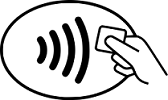
If you have this symbol on the front of your debit card, you can start using the contactless method of paying immediately.
