Person 1 (Charlie Nunn):
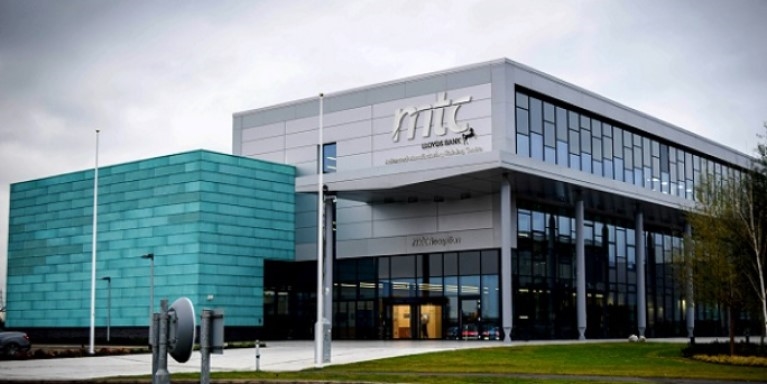
The MTC is powering the design and adoption of cutting-edge technologies and critical skills. We've been a proud partner for over 10 years, sponsoring 5000 apprentices. The future of UK engineering and advanced manufacturing is where innovation meets industry.
Person 1 (Charlie Nunn) speaking to Louis Carney:
Louis it's brilliant to be with you here at the MTC in Coventry. Now, we don't know each other well enough, but I'm a bit of a tech nerd and it's like being a kid in a toy store looking around here. I can't not have the opportunity to talk to you about what's behind us, this factory in a box.
Person 2 (Louis Carney):
This is created as a technology demonstrator to really show the full potential of digital automation and robotics as a whole system. This is a standard 40-foot shipping container, which we built a full end-to-end production line inside of that needs no human intervention and all you need is stock in one side, and you'll get the finished part out the other.
This can be bought anywhere in the world and all controlled digitally from a central dashboard. There's a huge variety of applications for this. For example, how do we deal with the seasonal labour and the really lumpy demand in things like orchard picking?
You ship one of these to the orchard, apples get fed in one end, they get packaged up, and they get wrapped, they get palleted, and they come out the other end ready to ship.
Person 1 (Charlie Nunn):
Developing the talent of the future, but also the automation and robotics of the future. How do you see those two things coming together? Because at some level they feel like it could be in conflict.
Person 2 (Louis Carney):
A lot of the companies we work with their initial worry is that if I introduce automation and robotics, it's going to take the jobs of the people within the business and that is something that we've not found at all and has been demonstrated by other countries such as Germany.
So, if we look at the adoption of robotics and automation in the UK, we're around 25th in the global rankings. The more you can adopt robotics and automation, actually the more jobs it creates. It removes people from the dangerous jobs, the repetitive jobs, difficult dirty jobs, to work on higher skill, higher wage, more interesting jobs, so you can upskill them with the skills their going to need for the future.
What we’ve developed here is a haptic feedback system that will allow you to control the robot. You’ll be able to feel the difference between a tennis ball, a hard block, and glass, and you also feel the weight of it as well.
Person 1 (Charlie Nunn) using the feedback system:
Yeah, that’s really haptic, isn’t it? Am I above it there? I am.
Person 2 (Louis Carney) speaking to Charlie Nunn using the feedback system:
A little bit further down, I think.
Person 1 (Charlie Nunn):
I lost it. He let go.
Person 2 (Louis Carney):
There you go. You got it.
This is initially developed for nuclear decommissioning, but there's a number of different applications, imagine bomb disposal, disaster relief as well, being able to pick through rubble and try and find and seek people who may have been missing.
Person 1 (Charlie Nunn):
It's unbelievable.
Person 2 (Louis Carney):
This is what we call our Speed 3D, so, this is a rapid, rugged eyes metal 3D printer. This was initially created for a mining company in Australia. They've got legacy parts in their mining equipment and when they fail out on site hundreds of miles away from manufacturing facilities, it takes them weeks, sometimes months, to get replacement parts sent out. So, this is initially developed to be able print those metal parts on the site and get the kit up and running as quickly as possible.
Person 1 (Charlie Nunn):
That's awesome. Really interesting. Yeah, really, really good.
Person 2 (Louis Carney):
Here at the MTC, we have the largest variety of laser research in the UK. We have lasers that go up to 50 kilowatts that can weld and cut up to 30 centimetres a piece of metal. So huge, really thick items, all the way down to laser to be able to cut holes at my microns.
Person 1 (Charlie Nunn):
Advanced manufacturing is a huge growth area. How do you then tap into the innovation and also the role you play around building skills and scaling skills?
Person 2 (Louis Carney):
Our links with academia and industry are what makes that really important. Making sure that we've got apprentices, so that we've got people being upskilled in the technologies that the country's going to need in the future to really thrive. Digital, AI, robotics, having the push and the pull from both industry and academia and us bridging that gap in the middle. We're actually, I think it's the 6th largest provider of apprenticeships in the UK.
There just isn't really enough big skills providers who are looking at the manufacturing, engineering side of things.
Person 1 (Charlie Nunn):
Now I had a chance today to meet some of the apprentices who are just brilliant, 16, 17, 18 year olds coming in and learning really advanced technologies, but doing it practically. It feels like to be the leader in advanced manufacturing. The UK needs 10 times, probably 100 times, what the MTC is doing today.
Person 2 (Louis Carney):
It does definitely.
Person 1 (Charlie Nunn) speaking to Martins Freimanis and Rahma Omar:
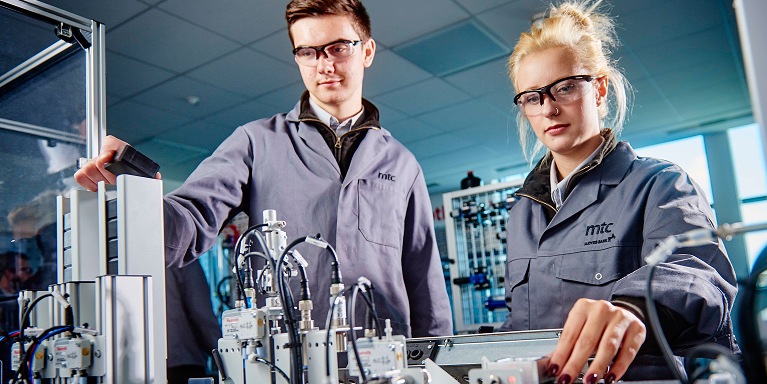
So Martins, Rahma, it's brilliant to meet two of the 5000 apprentices that Lloyds is so proud to sponsor.
Person 3 (Rahma Omar):
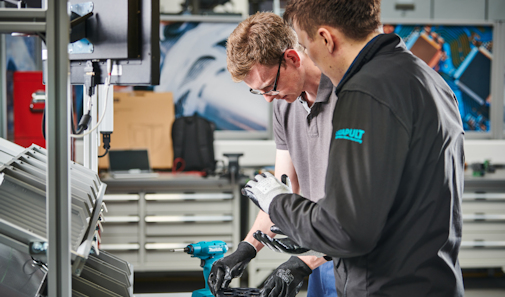
I started off my apprenticeship over the road at MTC training and we mainly worked on manual turning, manual CNC. Between my second and third year I was still on block releases filling in those knowledge gaps and now because I'm my fourth year, I'm purely based just in industry and just working towards the end of my apprenticeship.
I'm currently based in the metrology lab, basically the science of measurements. We work on a GOM, which is like essentially a big camera that takes loads of pictures of a part and turns it into a CAD model. And we also go old school and we work with first principles equipment.
Person 1 (Charlie Nunn):
I've heard people say, the phrase, the line must not stop. Is that why you learn about the principles of engineering alongside all the advanced technologies and practices?
Person 3 (Rahma Omar):
Starting off with the basics, was the foundation. So, when you go into real industry, you're able to see the changes and the development and the future of engineering and manufacturing.
Person 2 (Louis Carney) speaking to Charlie Nunn:
There is huge skill shortages in the UK for manufacturing and engineering jobs. 95% of the UK manufacturer businesses are SMEs. It's all well and good as developing, you know, the automation, the digital robotics and introducing the SMEs to it. Unless they've got confidence that the investment they are going to make in the kit, in the skills, in the people is going to really drive improvement for them and help them grow their business.
It's really difficult for them. They can come here, use the equipment, they can speak to our trained engineers and re-skill their staff, hugely de-risking what they're trying to do and how they're trying to grow.
Person 1 (Charlie Nunn) speaking to Martins Freimanis and Rahma Omar:
Martins, how about you? Why did you choose this training course in the apprenticeship structure of the MTC?
Person 4 (Martins Freimanis):
First main thing that I actually looked at is how much practical stuff I do, because if I went to university, guys just sitting in a classroom and doing a lot of theory and no experience.
So I thought I would do an apprenticeship. The groups are pretty small. Everybody understands it better. I actually made this turning, which is my absolute favourite.
Person 1 (Charlie Nunn):
What is that?
Person 4 (Martins Freimanis):
Machined jack. Just a little piece of brass which has a thread on the inside.
Person 1 (Charlie Nunn):
Amazing. Because you work with industry and practical use cases, you also have options at the end to either join industry or stay with the MTC.
Person 3 (Rahma Omar):
Last week, I was able to attend a manufacturing event that Lloyds set up, and I was able to build so many connections and learn about other people's stories, which was a great experience. I'm enjoying it so much so far. I feel like I just want to learn more about the new technologies that are coming to MTC.
Person 1 (Charlie Nunn) speaking to Louis Carney:
And part of this is developing new IP, new innovative technologies, and then making them scale in industry.
Person 2 (Louis Carney):
Whatever we develop they can have, they go and use, and they go and really drive into industry.
Our role is to give government and industry an idea of novel, innovative, ground breaking technologies that are going in five and ten years, make a difference. Using technology to its full potential is of huge benefit to the UK going forward.