Change your business address
If you're a full access user, you can update your business, registered, mailing and personal addresses within Online for Business and the Business banking app.
From 10 July 2026, some of the fees for our Business Account are changing. Read the guide to changes for details.
A dedicated business bank account for sole traders and freelancers makes self-employed finances simpler. Focus on the work, not the paperwork.
Open a Business Account with us online and get £200. How’s that for a helping hand?
Three steps to unlock your £200 business boost:
Apply between 1 June and 30 June, then by 30 September:
Terms and conditions of the £200 offer
Your approvers are people listed as signatories on your account. You can find this information on your bank mandate. Your bank mandate is the set of instructions given to us when your business account is opened. Contact us on 0345 072 5555 if you have any queries.
Find all the other accounts we offer, including those for schools, charities and community organisations.
Boost your start up with Business Debit Card offers - including LinkedIn Premium and Google Workspace.
These Terms and Conditions explain how this offer works, including who can take part, and what you need to do to receive the payment.
In these terms and conditions “we”, “us” or “our” means Lloyds Bank plc.
1. About this offer
This offer is available to new business customers who apply online for a Business Account between 1 June and 30 June 2026, subject to the eligibility requirements below.
This offer is also available to customers who switch an existing current account held with another bank to us, using the Current Account Switching Service (CASS), once their new account with us is open.
The Business Account, and any transactions made on the account, will be subject to the terms and conditions for the account. Fees and charges may apply.
2. Who can take part
You can take part, if both of the following apply:
3. What you need to do to receive the £200
You’ll qualify for the £200 payment if, by 30 September 2026, we have opened your Business Account and:
Make sure there’s enough money in your account, or that you have an authorised overdraft in place (if available on your account) before you spend on your debit card or your direct debits are taken. If you don’t, your account may go into an unauthorised overdraft, and you may be charged fees and interest as set out in your account terms and conditions.
Eligible debit card spending
Debit card spending means purchases of goods or services using your Visa debit card.
Excluded transactions
The following do not count towards the £100 spend requirement:
Direct Debits
Direct debits must be set up with the organisations you’re paying.
If you’re switching to us using the Current Account Switch Service (CASS), any active direct debits moved to your new account as part of the switch will count towards the requirement to set up two direct debits from your account.
4. What do we mean by ‘opening your Account’?
Your Business Account is opened on the date we send you your sort code and account number. This will be after you applied online.
5. When we'll pay you
If you meet the eligibility requirements above, we’ll pay £200 into your new Business Account by the end of October 2026. We’ll email you before we make the payment to let you know when to expect it.
Your Business Account must be open and able to receive payments at the time we try to make the payment.
We can’t pay the £200 into any other account or by cash or cheque.
The £200 payment is made gross, and you’re responsible for paying any tax due on the payment you receive.
We won’t contact you if your Business Account doesn’t meet the offer requirements.
6. Other important information
It’s highly recommended. You could use a personal account, but mixing business and personal transactions makes it harder to track profit and loss, increases the chance of missing deductible expenses, and can complicate your self-assessment for income tax.
A business account also helps you build a commercial credit profile, which can be important if you apply for lending later.
A personal account is exactly that - designed for personal use. A dedicated sole trader bank account is usually the better option for your business. With a sole trader business bank account, you can see exactly what’s happening with your business finances, making it easier to track income and expenses and prepare for your income tax self assessment. And it can help you build a commercial credit profile, which may be important if you apply for lending later.
HMRC is digitising Income Tax reporting for sole traders and individual landlords already registered for Self Assessment. If your qualifying income for the 2024/25 tax year was over £50,000, there’s new rules for how you report information for Income Tax.
Instead of submitting a single Self Assessment tax return once a year, sole traders and landlords with qualifying income will need to:
A Business Account from Lloyds can help you follow these new rules. If you open a Lloyds Business Account and your business meets the Making Tax Digital for Income Tax requirements, you’ll get access to our new accounting tool. It’s HMRC-recognised and designed to make it easier for you to manage your tax obligations.
And, if you’re self-employed, there are more benefits to having a sole trader bank account with Lloyds Bank:
A dedicated sole trader bank account keeps your business income and personal spending in separate places, which makes Self Assessment significantly easier. When tax time comes around, your business transactions are already in one place, making it straightforward to calculate turnover, expenses, and profit – instead of looking through 12 months of mixed statements.
Lloyds Business Account holders also get free Making Tax Digital software, automatically available if your business falls under the new HMRC rules. It’s a practical head start for self-employed people navigating the shift.
It won’t file your return for you, but it gives you the clean financial record HMRC expects.
A personal account is designed for everyday spending. A sole trader business account is built for how a business actually runs: separating your income from your personal finances, making expenses easier to track and giving you a professional payment record from day one.
Sole traders don’t need to have a separate account. But mixing business and personal money is one of the most common headaches experienced by new business owners. A new business bank account makes the distinction clear from the start and keeps it that way.
Yes. You can easily switch banks to a Lloyds Bank sole trader business account using the Current Account Switching Service (CASS). Once you’ve given us your details, you can sit back and we’ll manage the rest for you.
If you’ve already started an online application, you can continue or check the status of your application at any time using the log on button in your welcome email, which you’ll get once you’ve shared your personal details.
Find out more about our Business Account fees and charges.
|
Payment type |
Charges |
|---|---|
|
Payment type Introductory offer |
Charges No monthly account fee for 12 months if it’s your first business account with us |
|
Payment type Monthly account fee |
Charges £8.50 after 12 months |
|
Payment type Electronic payments in2 |
Charges Free |
|
Payment type Electronic payments out2 |
Charges First 100 a month are free / £0.20 each after that |
|
Payment type Cash payments (in or out) |
Charges £0.85 for every £100 at an Immediate Deposit Machine / £1.50 for every £100 over the counter |
|
Payment type Cheques (in or out, any amount) |
Charges £0.85 at an Immediate Deposit Machine / £1 over the counter |
|
Payment type Credit paid in at branch or ATM |
Charges £0.85 |
|
Payment type Credit paid in at an Immediate Deposit Machine, Automated Deposit Machine, through the app |
Charges Free |
|
Payment type BACS |
Charges File submission: £5.50 BACS Item: £0.15 (a set up fee may apply) |
|
Payment type CHAPS |
Charges £30 |
|
Payment type Sending and receiving money abroad |
Charges |
|
Payment type Balances below £0 (going overdrawn) |
Charges |
|
Payment type Other account services |
Charges |
No credit interest is payable on this account.
See the full account rates and charges (PDF, 232KB) and product terms and conditions.
Estimate with our calculator how much your business account could cost per month after the first year.
The Financial Services Compensation Scheme (FSCS) protects up to £120,000 of the eligible money you hold with us.
Published February 2026
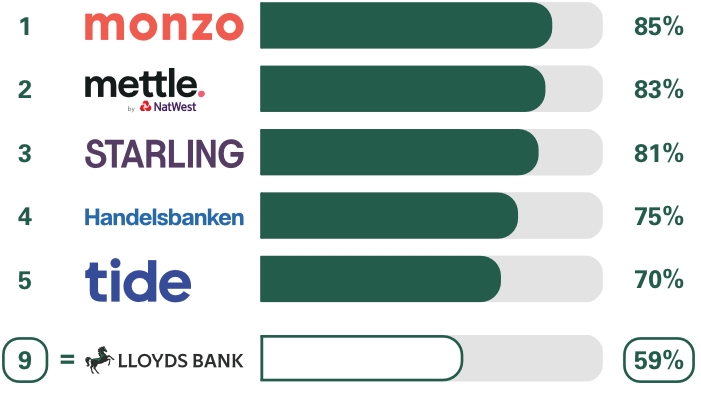
As part of a regulatory requirement, an independent survey was conducted to ask approximately 1,200 customers of each of the 17 largest business current account providers if they would recommend their provider to other small and medium-sized enterprises (SMEs*). The results represent the view of customers who took part in the survey.
We asked customers how likely they would be to recommend their business current account provider to other SMEs.
*SMEs include businesses, clubs, charities and societies with an annual turnover/income of up to £25m (exclusive of VAT and other turnover-related taxes).
The requirement to publish the Financial Conduct Authority Service Quality Information for business current accounts can be found here