Change your business address
If you're a full access user, you can update your business, registered, mailing and personal addresses within Online for Business and the Business banking app.
Demand for electricity is accelerating rapidly, driven by data centre growth, reindustrialisation, and the electrification of the economy, but the ability to deliver new capacity is struggling to keep pace.
Read time: 4 mins Added: 06/07/26

The market is no longer defined by access to capital or demand fundamentals, but by the ability to execute: navigating grid constraints, policy uncertainty, and increasingly complex delivery pathways.
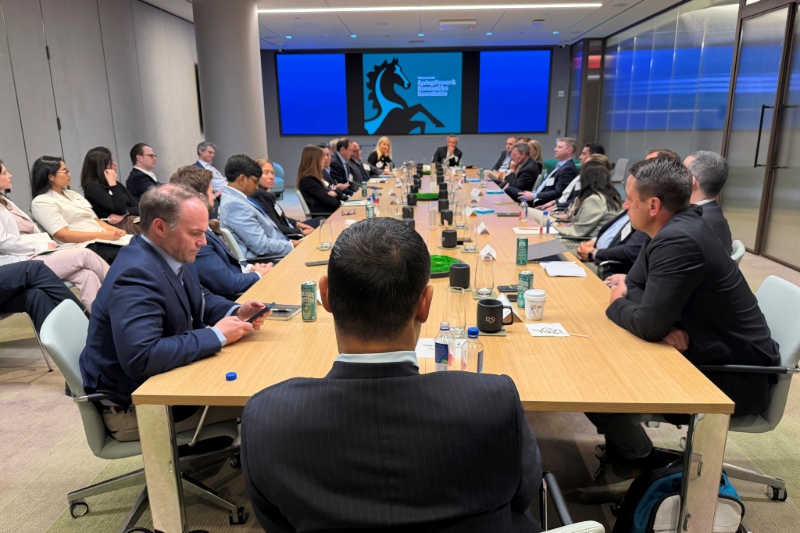
At our recent Spring Power & Renewables Roundtable in New York, Lloyds North America convened developers, utilities, investors, lawyers and advisers to explore the trends shaping the sector, and how these dynamics are influencing investment strategies, development approaches, and the broader energy system.
Below are the three key insights from the roundtable.
Participants were aligned on the strength of underlying power demand.
Demand growth is being driven by a combination of structural factors. Data centres dominate headlines, described during the roundtable as an “avalanche” of activity, with hyperscalers prioritising speed and certainty of supply. Data centres are expected to account for a significant part of near-term load growth, with the balance of demand driven by reindustrialisation and the electrification of transport, buildings, and industry. This reflects a broader shift towards a more electrified economy, with demand emerging across multiple sectors rather than a single dominant source.
Against this backdrop, deliverability, not demand, is the critical constraint. Interconnection queues are lengthening, with increasing concerns on timing. Regional grid operators: ISOs (Independent System Operators) and RTOs (Regional Transmission Organisations), play a central role in managing grid reliability and coordinating generation and transmission. Developers are increasingly engaging earlier with these operators, and, in some cases, funding network upgrades directly to accelerate timelines and secure queue positions.
Additional pressures are emerging across the delivery process. Permitting scrutiny is increasing, with greater regulatory and community focus on environmental impacts, land use, and local opposition to new infrastructure, resulting in longer approval timelines and greater uncertainty. At the same time, tariffs on imported equipment, particularly across solar, wind, and storage supply chains, are increasing capital costs and complicating procurement strategies.
As a result, development strategy is shifting. Planning is becoming a primary driver of value, with developers placing greater emphasis on location, prioritising regions with available grid capacity, faster interconnection pathways, and supportive siting frameworks. Increasingly, the defining factor is not resource type, but the ability to connect and deliver firm reliable power quickly.
Policy uncertainty - particularly around US tax credits and evolving Foreign Entity of Concern (FEOC) rules - is shaping deal execution, especially for Investment Tax Credit (ITC) based structures such as Section 48E (the Clean Electricity Investment Credit).
ITCs remain a critical driver of project economics, offering a significant upfront tax offset on costs, while the new Section 48E regime extends eligibility to all zero-emission generation on a technology-neutral basis. However, recent FEOC restrictions, linked to foreign ownership, influence, and supply chain inputs, have introduced new layers of complexity.
The FEOC restrictions combined with enhanced supply chain tracing requirements, have significantly increased the due diligence burden for developers, making compliance more complex and introducing additional execution risk. As a result, compliance continues to be operationally challenging.
This is driving a broader shift in the market: financial structuring is no longer a secondary consideration, it is central to execution, directly shaping deal certainty, timing, and overall transaction momentum. Participants highlighted the continued depth of capital across power and renewables, with strong deployment pressure from private credit and infrastructure funds supporting competitive pricing.
However, selectivity is increasing. As the complexities outlined above, from policy uncertainty and tax credit evolution to interconnection delays and delivery risk, take hold, investors are placing greater emphasis on certainty of execution and downside protection.
There is a clear shift towards operating or near-operational assets, with heightened scrutiny of project counterparties, documentation, and execution timelines. Investors are increasingly focused on interconnection risk, regulatory exposure, supply chain certainty, and revenue quality, alongside the strength of off takers and contracted cash flows.
While liquidity remains robust, market dynamics are becoming increasingly more complex. Careful attention to due diligence and early-stage planning is essential to avoid delays, repricing, or compliance risks. Developers with a strong track record and experience navigating this environment are clearly differentiating themselves and performing best.

For clients in North America with strong links to the UK. See the benefits of our client-oriented approach.

Five strategic insights from Lloyds’ Powering Tomorrow Roundtable on renewables: policy, resilience, and investment strategies shaping the US energy transition.

Our essential resource for economic reports, market intelligence and the latest forecasts.
For the latest insights follow our dedicated LinkedIn channel for North America.