Change your business address
If you're a full access user, you can update your business, registered, mailing and personal addresses within Online for Business and the Business banking app.
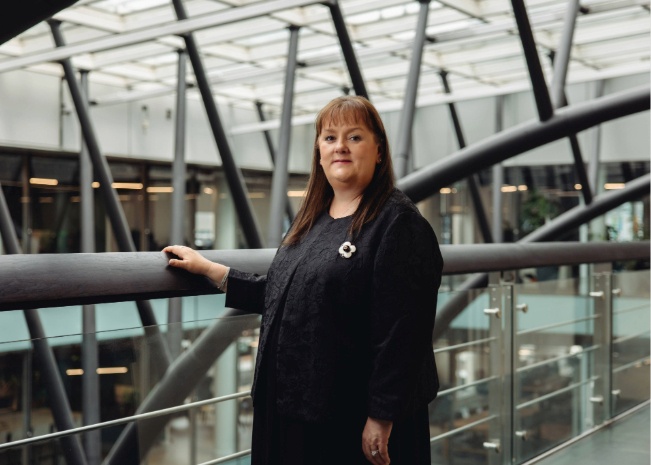
Lloyds’ Business and Commercial Banking Chief Executive Amanda Murphy explains how companies can realise their full potential.
Read time: 8 mins Added: 06/10/26
Partner content

For UK businesses, the difference between thriving and surviving may be the ability to anticipate change and respond with purpose, says Amanda Murphy, Lloyds' CEO of Business and Commercial Banking: “The businesses creating momentum are investing through uncertainty, while competitors wait for perfect conditions.”
Murphy joined Lloyds earlier this year, with a multi-decade career in commercial banking. Her work with a wide range of SMEs has provided real insight into how founders can be on the right side of disruption and turn it to their advantage.
This is particularly important today, with multiple pressures on small businesses.
Amanda Murphy CEO, Lloyds Business and Commercial BankingThree forces dominate almost every boardroom conversation today, policy, technology and international trade. The businesses creating momentum aren't simply reacting to change, they’re using it to reshape how they compete, invest and grow. The winners won’t be those who respond fastest to change, but those who understand how these trends reinforce one another.
AI, for example, remains a formidable opportunity for companies, but also a risk. It promises to be as transformative as the internet revolution, but with even greater disruption for UK businesses. Murphy is already seeing businesses adjust, with AI solving diverse problems, from managing accounts to recruitment to keeping stock and inventory at good levels. “Great businesses are using AI very consistently,” she says.
How can businesses embrace these shifts and plan for the future? Murphy says that starts with an examination of their ambitions, the resources they need and the different steps they need to take. “That might be to grow, to expand. It might be to upgrade machinery or equipment, or take on new people, always keeping the customer as their North Star.”
Murphy says fewer than one in four businesses seek out finance, meaning that many potentially miss out on growth opportunities. High-growth “scale-up” businesses use external finance significantly more than their peers, reinforcing the role that targeted investment can play in accelerating growth. Discussion over finance should be collaborative. A good lender should be able to help founders firm up ideas and execute flawlessly.
That means picking a financing partner with a breadth of expertise. “Most business challenges don’t fit neatly into product categories,” says Murphy. “Businesses don’t wake up wanting a loan, a trade solution or a pension product. They wake up trying to solve a growth problem.”
Equally, she says, growth does not look the same everywhere. “There is no single UK economy; there are dozens of regional economies, each with different opportunities, challenges and strengths.” Manufacturers in the Midlands may be focused on supply chains and exports, while technology businesses in London and the South East may be prioritising talent and investment. Her view is that the strongest relationships are built on a nuanced understanding of a client’s ambitions and in helping them navigate whatever comes next.
Lloyds’ partnership with the Manufacturing Technology Centre allows manufacturers to access expertise in automation, digitalisation and advanced technologies to improve productivity and efficiency. The partnership has so far helped train more than 5,200 apprentices, graduates and engineers.
Culture is also important in remaining agile, says Murphy. Cultural change doesn’t happen automatically, but starts with clear purpose and strong leadership that encourages people to innovate and challenge established thinking. People need to feel confident to bring forward new ideas. This can be crucial in ensuring businesses can navigate a shifting business environment and harness new opportunities.
This is a challenging but fertile time for the UK’s small businesses. “Successful founders are always learning,” says Murphy. “They’re always looking in the marketplace for new ideas. They’re always thinking about how they can adapt and how they can create, and they never take a no. They’re always looking for ways to make it happen.”
All lending is subject to status. Eligibility criteria apply. Lloyds Bank data correct as of April 2026. Figure includes clubs, charities and societies.