
Pension tax relief
By making the most of tax relief and allowances, you can maximise your retirement savings to help secure a comfortable future.

How much pension tax relief do I get?
The amount of tax relief you get depends on the level of income tax you pay. Here’s a quick overview for a personal pension:
- Everyone will get 20% basic tax relief automatically added to their personal pension contributions. This means for every £80 you pay into your personal pension, you get £20 tax relief added automatically, meaning the total amount contributed is £100.
- Higher or additional rate taxpayers, who pay tax on some income at 40% or 45%, can also claim-back the extra from HMRC through Self-Assessment. This isn’t done within the personal pension itself*.
*If you have a workplace pension, depending on the type, you may find that your full tax relief has already been applied to your contributions for you by your employer. You should check with your employer if unsure.
It quickly adds up
Here’s how tax relief works when you’re saving into a personal pension if you wanted to contribute a total of £1,250 into your pension for example:
A basic rate taxpayer:
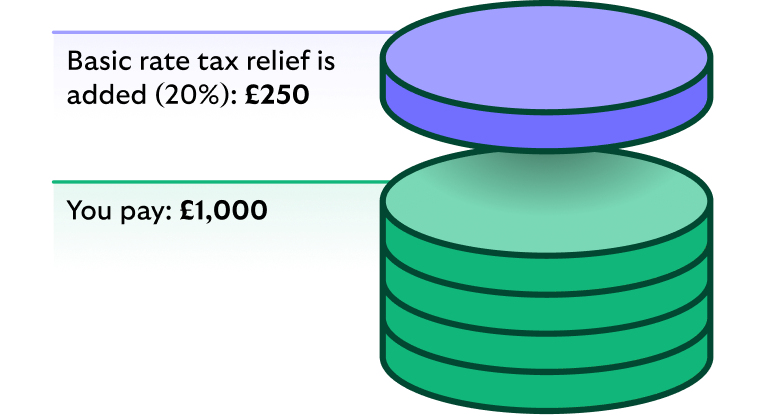
Total contribution of £1,250
A higher rate taxpayer:
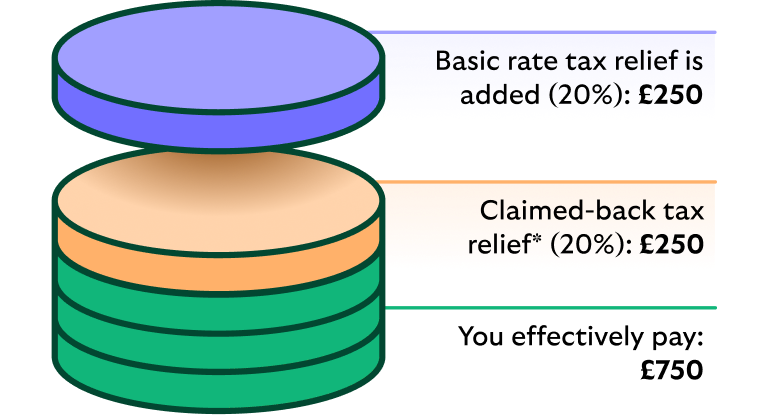
Total contribution of £1,250
*By claiming back the additional 20% higher rate tax relief through self-assessment, this effectively means you’ve only paid £750 towards a £1,250 total pension contribution. If you live in Scotland, or are an additional rate taxpayer, the reclaimed tax amount could be more.
This is why higher and additional rate taxpayers, who are saving into a personal pension, should remember to complete a Self-Assessment to claim back the tax relief they’re entitled to.
The power of tax relief
A pension is a powerful way to save because the added tax relief boosts its value. Over time this compounding effect can really add up. It makes sense to start a pension as early as you can – to benefit from as many years of tax relief as you can – and keep it invested for as long as possible. The more time it’s invested, the more opportunity it has to grow. And it’s never too late to start.
Tax advantages of saving into a pension
Pensions are an attractive investment option for long-term retirement planning in two main ways:
- The tax relief boost you get on your own pension contributions, means it costs you less to pay into your pension and your money can grow faster than it could do in other tax-efficient accounts such as ISAs.
- Pension investment gains are not subject to UK Capital Gains Tax (CGT). By not paying CGT, your investments can grow unhindered, allowing you to accumulate a more substantial pension pot for your retirement.
Do I need to claim tax back?
How you receive the pension tax relief you’re entitled to depends on the type of pension you’re paying into:
- If you have a personal pension, because you’ve already been taxed on the income you’re paying in, it needs to be added back. Your pension provider claims tax relief for you from HMRC in order to automatically add the basic rate of 20% to your pot. If you’re a higher or additional rate taxpayer, you need to claim back the additional tax you’re eligible for through your annual Self-Assessment.
- If you have a workplace pension, your employer usually takes your pension contributions out of your pay before deducting Income Tax. This means you haven’t paid tax on these contributions, so you don’t need to claim anything back.
The technical terms
-
If you’re contributing to a personal pension and are a higher or additional rate taxpayer (so paying more than 20% tax), you need to claim the additional tax relief you’re entitled to on these contributions through the annual Self-Assessment process. You can choose to take this as tax rebate, an adjustment to your tax code, or a reduction in your overall tax bill.
-
Workplace pensions often operate a Net Pay scheme. This means your employer deducts your pension payments from your gross salary (before you pay tax), and you only pay tax on what is left. Your employer does this for you and it shows in your pay cheque. This ensures you receive the right level of tax relief, no matter which tax band you are in, without having to claim anything back from HMRC.
Income tax thresholds
The current income tax bands for England and Wales.
|
Band |
Taxable income |
Tax rate |
|---|---|---|
|
Band Personal Allowance |
Taxable income Up to £12,570 |
Tax rate 0% |
|
Band Basic rate |
Taxable income £12,571 to £50,270 |
Tax rate 20% |
|
Band Higher rate |
Taxable income £50,271 to £125,140 |
Tax rate 40% |
|
Band Additional rate |
Taxable income over £125,140 |
Tax rate 45% |
You can find this year's income tax bands for Scotland at GOV.UK.
Your annual allowance
There are limits on how much tax relief you can get each year. This annual allowance applies across all your pension contributions. It affects how much you or anyone else paying into a pension on your behalf (for example your employer) can pay into it without a tax charge.
For this tax year, your allowance is the lowest of the following:
- £60,000
- 100% of your UK earnings if you earn less than £60,000
- £3,600 if you receive no UK earnings.
Your allowance resets each tax year. It’s also possible to ‘carry forward’ your last three year’s allowances to add to this year’s. You’ll need to contact HMRC to do this.
There are some other circumstances where your annual allowance may differ. These are:
-
Very high earners have a lower annual allowance, called the Tapered Annual Allowance. The taper applies if your 'threshold income' (your annual income before tax less any personal pension contributions and ignoring any employer contributions) is over £200,000.
If your threshold income is above this, then you need to check if your 'adjusted income' (your annual income - including dividends, savings interest and rental income - before tax, plus the value of your own and any employer pension contributions) is over £260,000. If it is, the annual allowance will reduce. If it is above £260,000, the annual allowance will reduce by £1 for every £2 that your ‘adjusted income’ exceeds £260,000. The maximum reduction is £50,000 once adjusted income reaches £360,000. Please speak to your financial adviser for more details. You can find more information at www.moneyhelper.org.uk.
-
If you withdraw money flexibly from a pension you will also be subject to a reduced annual allowance, which is currently £10,000. This is called the Money Purchase Annual Allowance (MPAA). You will have been told by your pension provider if the MPAA applies to you and to notify your other pension providers within 91 days or you could be subject to a fine.
You may also like
Starting out?
Read our simple 5-step guide to help decide if investing is right for you.
Resilient investing
Read our essential principles for when facing stock market volatility.
